Showing posts with label FHA minimum credit score. Show all posts

What is an FHA Loan and Is It Right for You?

Last Updated: 2026 – Kentucky FHA Loan Guidelines, Limits, and Requirements Reviewed for Accuracy

Kentucky FHA Loans in 2026: What Is an FHA Loan and Is It Right for You?

An FHA loan is a government-backed mortgage insured by the Federal Housing Administration. FHA loans in Kentucky remain one of the most flexible mortgage options for buyers who may not qualify for conventional financing due to credit challenges, limited savings, or higher debt-to-income ratios.

Because FHA loans are insured by the federal government, approved lenders can offer more forgiving qualification standards while still managing risk.

External reference: What is an FHA Loan and Is It Right for You?

FHA Loan Requirements in Kentucky (2026)

  • Minimum credit score: 580 for 3.5% down
  • 500–579 credit scores may qualify with 10% down (lender overlays apply)
  • Debt-to-income ratios allowed up to 56.99% with strong compensating factors
  • Stable, verifiable income required
  • Mortgage insurance is mandatory on all FHA loans

What Can an FHA Loan Be Used For?

  • Single-family homes
  • FHA-approved condominiums
  • 2–4 unit properties (owner-occupied)
  • Manufactured homes meeting FHA standards
  • Renovation loans (203k)
  • New construction with approved builders

Kentucky FHA Loan Limits

FHA loan limits vary by county and are updated annually.

View current Kentucky FHA loan limits by county

FHA Mortgage Insurance Explained

  • Upfront mortgage insurance premium: 1.75% (usually financed)
  • Annual mortgage insurance: typically 0.45%–1.05%
  • Mortgage insurance often lasts for the life of the loan

Pros and Cons of FHA Loans in Kentucky

Advantages include lower down payments, flexible credit requirements, and compatibility with Kentucky down payment assistance programs. Disadvantages include mandatory mortgage insurance and stricter property condition standards.

Applying for a Kentucky FHA Loan

You must work with an FHA-approved lender and provide documentation such as income verification, bank statements, and authorization to pull credit. Some documentation may be retrieved electronically by your lender.

Explore Other Kentucky Mortgage Programs

Kentucky FHA loan requirements infographic showing credit scores, down payment options, debt-to-income limits, and 2026 loan limits by unit type

Kentucky Credit Score Requirements for Mortgage Approval – FHA, VA, USDA, Fannie Mae & KHC

Thinking about buying or refinancing a home in Kentucky and wondering what credit score you need? Your credit score is one of the key factors lenders look at when deciding whether to approve your mortgage and what interest rate to offer.

As a Kentucky mortgage loan officer who has helped over 1,300 families across the state, I work every day with first-time homebuyers, repeat buyers and homeowners looking to refinance using programs like FHA, VA, USDA Rural Housing, Conventional (Fannie Mae) and Kentucky Housing Corporation (KHC) down payment assistance.

This guide breaks down typical credit score benchmarks for Kentucky mortgage approvals and explains what you can do if your scores are not quite where you want them yet.


Why Your Credit Score Matters for a Kentucky Mortgage

When you apply for a mortgage in Kentucky, the lender pulls your credit from the three major bureaus and uses your middle score (or the lower middle score if there is more than one borrower).

Your credit score helps the lender evaluate:

  • How likely you are to pay on time
  • Your history of managing credit cards, auto loans and other accounts
  • How much total debt you are carrying compared to your limits
  • Past issues like collections, charge-offs, bankruptcies or foreclosures

Important: There is no single “magic number” that approves or denies every Kentucky mortgage. Each program has its own guidelines, and many lenders add their own internal rules, called “overlays.” Your income, debt-to-income ratio (DTI), job stability and property type all matter too.


Typical Credit Score Minimums by Loan Type in Kentucky

Below are common credit score benchmarks used by many lenders for Kentucky borrowers. These are general guidelines and can change based on lender, market conditions and your overall profile.

Loan Type Typical Minimum Credit Score Notes for Kentucky Borrowers
FHA (Federal Housing Administration) 580+ for 3.5% down
500–579 possible with 10% down (lender approval required)
Very popular with first-time homebuyers and buyers with limited down payment or past credit issues.
VA (Department of Veterans Affairs) No official VA minimum; many lenders look for 580–620+ For eligible Veterans, Active Duty, Reservists and some surviving spouses. No monthly PMI and flexible guidelines.
USDA (Rural Housing) Often 620–640+ for automated approval $0 down for eligible rural areas in Kentucky. Lower scores may require more documentation and manual underwriting.
Conventional (Fannie Mae/Freddie Mac) Generally 620+ minimum Stronger scores (680–740+) can mean better interest rates and easier approval, especially with lower down payments.
Kentucky Housing Corporation (KHC) Varies by program; many options start around 620+ Often paired with FHA, VA, USDA or Conventional loans for down payment and closing cost assistance for Kentucky homebuyers.

Note: These are typical ranges only. Final approval depends on full underwriting and your complete financial profile.


How Your “Qualifying” Mortgage Credit Score Is Calculated

When you apply, your lender orders a tri-merge mortgage credit report from:

  • Experian
  • Equifax
  • TransUnion

For most Kentucky mortgages, the lender uses the middle score of the three bureaus as the “qualifying” score. If there are two borrowers, the lender usually uses the lower of the two middle scores.

Example:

  • Borrower A: 598, 625, 604 → Qualifying score = 604
  • Borrower B: 640, 659, 652 → Qualifying score = 652

If both apply together, the lender may qualify the file off the lower middle score, in this example 604.

Also keep in mind: mortgage lenders often use older FICO models (not the same as many “free” credit score apps), so your lender’s scores can look different from what you see on a credit monitoring website.


FHA Credit Score Requirements in Kentucky

FHA loans are a go-to option for many Kentucky first-time home buyers because they allow for lower down payments and more flexible credit guidelines than many conventional loans.

  • 580+ credit score: You may qualify for the minimum 3.5% down payment, subject to full underwriting.
  • 500–579 credit score: FHA will technically allow financing with at least 10% down, but many lenders set higher internal minimums. Expect a case-by-case review and stricter conditions.
  • Below 500: Usually not eligible for FHA financing. Work on credit repair first, then re-apply.

FHA also looks closely at your recent 12–24 month payment history, especially for any mortgage or rent, auto loans and major revolving accounts.

For more in-depth FHA information, you can also review my Louisville FHA guide here:
Louisville Kentucky First-Time Home Buyer FHA & KHC Programs


VA Credit Score Guidelines for Kentucky Veterans

The VA itself does not publish a strict minimum credit score. Instead, lenders set their own tolerances based on risk, experience and market conditions.

In practice for Kentucky VA home loans:

  • Many lenders look for 580–620+ as a baseline.
  • Stronger income, solid recent payment history and low DTI can help offset borderline scores.
  • Past credit events (bankruptcy, foreclosure, short sale) may require seasoning time and compensating factors.

VA loans can be extremely powerful tools for eligible buyers: no down payment in most cases, no monthly PMI, and flexible guidelines when structured properly.


USDA Rural Housing Credit Score Expectations in Kentucky

USDA Rural Development (Rural Housing) loans offer true $0 down financing in many areas of Kentucky. Because there is no down payment, lenders pay close attention to credit history and income stability.

Typical USDA score expectations:

  • 640+: Often qualifies for automated underwriting approval (GUS Accept), assuming the rest of the file is strong.
  • 620–639: May still be possible, but more documentation or a manual underwrite could be required.
  • Below 620: Case-by-case basis. Expect more scrutiny and a need for strong compensating factors like low DTI and reserves.

If you want to check whether a property might be USDA-eligible, you can start with my Kentucky USDA map and eligibility tools here:
Check if a Kentucky Property Is in a USDA Eligible Area


Conventional (Fannie Mae/Freddie Mac) Credit Score Benchmarks

Conventional loans backed by Fannie Mae or Freddie Mac usually require a stronger credit profile than FHA, VA or USDA.

  • 620+: Common minimum score for many lenders.
  • 660–679: Often required for certain products, lower down payments or riskier profiles.
  • 680–740+: Typically qualifies for more favorable pricing, especially with smaller down payments.

If you are trying to refinance out of FHA into a Conventional loan to remove mortgage insurance, or you want to pair a Conventional loan with KHC down payment assistance, your credit score can make a noticeable difference in interest rate and closing cost options.


How KHC (Kentucky Housing Corporation) Looks at Credit

Kentucky Housing Corporation (KHC) does not lend money directly to consumers, but it partners with approved lenders (like us) to provide down payment assistance and special programs.

In general:

  • Many KHC programs start around 620+ credit scores, depending on the specific product and loan type (FHA, VA, USDA, Conventional).
  • KHC overlays may be stricter than the underlying FHA/VA/USDA/Conventional guidelines in some areas.
  • Higher scores help with pricing, underwriting approval and access to more assistance options.

If you are a first-time homebuyer in Kentucky and need help with down payment or closing costs, we can review which KHC options fit your credit profile and income.


Refinancing vs. Purchasing: Does the Credit Score Requirement Change?

For most programs, the credit score ranges are similar whether you are purchasing or refinancing. However, the purpose of the refinance can matter:

  • Rate-and-term refinance: Often similar credit score and DTI guidelines as a purchase.
  • Cash-out refinance: Usually requires higher scores and more equity, especially for Conventional and VA cash-out.
  • Streamline refinances (FHA, VA IRRRL, etc.): May have more flexible credit documentation but still require a review of payment history and risk.

If you already own a home in Kentucky and want to lower your payment, shorten your term, or remove mortgage insurance, we can run side-by-side refinance scenarios based on your current scores.


5 Practical Ways to Improve Your Credit Before Applying

If your credit score is close to the cutoff, even a small improvement can open up better loan options and interest rates. Here are five practical steps:

  1. Pull and review your credit reports. Check Experian, Equifax and TransUnion for errors, duplicates or old derogatory items that should have fallen off.
  2. Lower your credit card balances. Try to keep utilization under 30% of your limits on each revolving account – lower is better.
  3. Avoid new loans or major purchases. Hold off on buying vehicles, furniture or opening new credit cards right before applying for a mortgage.
  4. Make every payment on time. A single 30-day late payment can drop scores and trigger underwriting issues.
  5. Talk to a Kentucky loan officer early. A customized credit review can show you which actions will give you the biggest boost toward mortgage approval.

Next Steps: Talk Through Your Kentucky Mortgage Credit Plan

Every borrower’s story is different. Two people can have the same credit score but very different credit histories and approval paths.

If you are:

  • A first-time homebuyer in Kentucky
  • Looking to refinance your current home loan
  • A Veteran or active-duty service member considering a VA loan
  • Buying in a rural area and exploring USDA Rural Housing
  • Interested in KHC down payment assistance

…I can help you review your credit, run loan scenarios and design a practical plan to get you approved.

Call or text: 502-905-3708
Email: kentuckyloan@gmail.com

Serving homebuyers and homeowners across all 120 counties in Kentucky.


Frequently Asked Questions About Kentucky Mortgage Credit Scores

What is the minimum credit score for an FHA loan in Kentucky?

Many lenders in Kentucky look for a 580+ credit score to qualify for the 3.5% minimum down payment on an FHA loan. Scores between 500 and 579 may be considered with at least 10% down, but approval is more difficult and not all lenders will allow it.

Can I get a Kentucky mortgage with a credit score below 580?

It can be possible, but options are limited. Some FHA and VA lenders may consider scores in the 500–579 range with stronger down payment, low debt-to-income ratio and clean recent payment history. In many cases, it is more effective to spend a few months improving your credit and then apply.

What credit score do I need for a VA loan in Kentucky?

The VA does not publish a hard minimum score, but many Kentucky lenders prefer 580–620+. Stronger scores can mean better terms, especially if you have prior credit challenges.

What credit score is required for a USDA Rural Housing loan in Kentucky?

USDA loans often work best with scores of 640 or higher for automated approval. Lower scores may still be considered, but expect more documentation, a manual underwrite and tighter qualification standards.

How can I improve my score quickly before applying for a Kentucky mortgage?

Common fast-impact steps include paying down credit card balances, bringing any past-due accounts current, avoiding new inquiries and disputing any obvious errors on your report. A targeted review with a Kentucky loan officer can help you focus on the items that will move your score the most.


Disclaimer: This information is for educational purposes only and does not constitute a commitment to lend. Program guidelines, credit score requirements and underwriting standards are subject to change without notice. All loans are subject to credit approval, income verification, acceptable collateral and program availability.

NMLS #57916  |  Company NMLS #1738461  |  Equal Housing Lender

Kentucky FHA Mortgage Information

Louisville Kentucky Mortgage Lender for FHA, VA, KHC, USDA and Rural Housing Kentucky Mortgages: Kentucky FHA Mortgage Information


 How to Qualify For a Kentucky FHA Mortgage Loan 1. Low Down Payment   –  FHA Mortgage Loans only require a 3.5% down payment. And what m...

How to Qualify For a Kentucky FHA Mortgage Loan


How Do Mortgage Companies Average the Score on All 3 Credit Reports?

How Mortgage Lenders Use All Three Credit Scores

Your credit score is a major driver in whether an automated underwriting system (AUS) such as Fannie Mae Desktop Underwriter or Freddie Mac Loan Product Advisor will approve your mortgage. Understanding how lenders interpret all three credit scores can help you prepare for FHA, VA, USDA, Conventional, or Kentucky Housing Corporation financing.


Why Mortgage Lenders Pull All Three Scores

Lenders use a tri-merge credit report that pulls information from the three national credit bureaus:

  • Equifax
  • Experian
  • TransUnion

Each bureau uses a different scoring model, which is why your three numbers are rarely the same. These differences are normal and expected.


Mortgage Lenders Pull All Three Scores Lenders use a tri-merge credit report that pulls information from the three national credit bureaus:  Equifax Experian TransUnion


To learn more about how credit scores work, visit Credit Scores for Kentucky Mortgages.

Factors That Impact Your Mortgage Credit Score

Several behaviors influence how your scores are calculated:

  • Payment history and recent late payments
  • Credit card utilization levels
  • Collections, charge-offs, judgments, and bankruptcy
  • Length of credit history
  • New credit and inquiries

For borrowers seeking FHA financing in Kentucky, these factors are critical because FHA scoring models weigh payment history heavily.

How to Improve Your Scores Before a Mortgage

Many people assume paying off every credit card boosts the score. In reality, mortgage scoring models reward active but responsible use of revolving credit.

  • Lower your credit card balances to 30–45 percent of the limit
  • Keep older accounts open to preserve credit age
  • Avoid opening new accounts before applying
  • Address any recent late payments or collections

For buyers preparing for a zero-down option such as a Kentucky USDA loan or Kentucky VA loan, maintaining strong and stable credit is essential for AUS approval.

How Lenders Select the Score Used for Approval

Mortgage lenders do not average your three scores. They use the middle score.

If your scores were 780, 776, and 790, the lender uses the middle score of 780.

For joint borrowers, lenders use the lowest middle score between both applicants.

Minimum Scores Required for Mortgage Programs

Different mortgage programs have different minimum credit score expectations:

  • FHA: 580 for maximum financing
  • VA: Lenders typically require 580–620
  • USDA: 620 for automated approval
  • Conventional (Fannie Mae/Freddie Mac): 620 minimum

Explore specific requirements for each program below:

External references for further reading:


KENTUCKY FHA LOAN CREDIT SCORE REQUIREMENTS

kentucky fha credit score requirements

What credit score do I need to qualify for Kentucky FHA loan is one of the most common questions lenders hear. The short answer is you must have a minimum credit score of 500 to be eligible for an Kentucky FHA loan. Higher scores will get you better terms and a smaller down payment requirement. Anything lower than 500 disqualifies you from consideration for an Kentucky FHA loan.


There are two sets of credit score requirements.


One important thing to understand is that the Federal Housing Administration (FHA) does not lend money directly to home buyers. You will fill out an application with a regular lender just as you would if you were applying for any other type of mortgage. What the FHA does is ensure your loan to help protect the lender in case you default. You will be required not only to meet the FHA guidelines to qualify for a loan but also meet any additional qualifications required by the lender. This means there are two sets of requirements you have to meet with your credit score.

1. The first set of requirements comes from the Department of Housing and Urban Development (HUD). HUD oversees the FHA and determines what a borrower’s minimum eligibility requirements will be to obtain an FHA loan.

2. The second set of requirements comes from the mortgage lender. The mortgage lender has the right to add its requirements to those mandated by HUD.

What HUD requires of borrowers to be eligible for an FHA loan


The HUD Handbook 4000.1 includes the official guidelines when it comes to the FHA mortgage insurance program.

It states that in 2020 the borrowers with credit scores of 580 or higher are eligible for a 96.5% loan with 3.5% down.

Borrowers with credit scores from 500 to 579 are eligible for a 90% loan with 10% down.

Individuals with credit scores below 500 are not eligible for the FHA program.

What lenders may require of borrowers to be eligible for an FHA loan


Lenders have the right to add requirements over and above the minimum requirements of HUD. These additional requirements are called overlays. Your lender may or may not require them. This is not something that should come as a surprise to you, however. Requiring a credit score of 580 to 620 is not unusual. In addition to your credit score, you must have a manageable debt level that lenders are comfortable with and enough income to repay your loan.

What credit score do I need to qualify for FHA loan?


These percentages show that the majority of borrowers who successfully qualify for FHA loans fall into the 600 to 799 range. While it is true that some successfully qualify in the low range of 500 to 599, you have a much better chance of being approved for a loan with good terms and a low down payment if you fall into the higher range.


Joel Lobb 

πŸ“ž Call/Text - 502-905-3708


 www.mylouisvillekentuckymortgage.com
 911 Barret Ave., Louisville, KY 40204


Evo Mortgage
Company NMLS# 1738461
Personal NMLS# 57916

Kentucky Mortgage Loan Expert For Kentucky FHA, VA, USDA, Fannie Mae and KHC Down payment Assistance Loans


Kentucky FHA Mortgage Guidelines for a Kentucky First Time Home Buyer


FHA Mortgage Manual Underwriting Video Guidelines


Kentucky FHA will consider the borrower’s entire story, including extenuating circumstances and compensating factors, to justify loan approvals. If your borrower falls under any of these conditions, they may benefit from manual underwriting:


  • Non-traditional credit / lack of credit
  • True extenuating circumstances affecting credit or income history
  • Lack of seasoning on a Chapter 13
  • Disputed accounts over $1,000
  • Frequent job changes in the last 12 months

If you think your borrower could benefit from  manual underwriting call us to learn more about manual underwriting or submit your scenario today.

Lowest Minimum Decision Credit Score 

Maximum Qualifying Ratios (%)

 Acceptable Compensating Factors

All manual underwritten loans require a VOR.

If the borrower does not pay rent a letter of explanation from borrower stating where living rent free.

31/43
• No compensating factors required.
• Energy Efficient Homes may have stretch ratios of 33/45.


37/47
One of the following:
• Verified & documented cash reserves equal to at least three total monthly mortgage payments.
• New total monthly mortgage payment is not more than $100 or 5% higher than previous total monthly housing payment, whichever is less; and there is a documented twelve-month housing payment history with no more than one thirty-day late payment.
• Residual Income per VA chart.


40/40
• Borrower has established credit lines in his/her own name (open for at least six months) but carries no discretionary debt (monthly total housing payment is only open installment account and borrower can document that revolving credit has been paid off in full monthly for at least the past six months).

40/50
Two of the following:
• Verified & documented cash reserves equal to at least three total monthly mortgage payments.
• New total monthly mortgage payment is not more than $100 or 5% higher than previous total monthly housing payment, whichever is less; and there is a documented twelve-month housing payment history with no more than one thirty-day late payment.
• Verified and documented significant additional income that is not considered effective income and likely to continue (part-time or seasonal income verified for more than 1 year but less than 2 years). The income if it were included in gross effective income is sufficient to reduce the qualifying ratios to not more than 37/47.
• Residual Income per VA chart.

Residual Income


Calculating Residual Income


Residual income is calculated in accordance with the following:
• Calculate the total gross monthly income of all occupying borrowers
• Deduct from the gross monthly income the following items:
➢ State income taxes
➢ Federal income taxes
➢ Municipal or other income taxes
➢ Retirement or Social Security
➢ Proposed total monthly fixed mortgage payment
➢ All recurring monthly debt obligations
➢ Estimated maintenance and utilities ($0.14 x sq. ft.)
➢ Job related expenses (e.g., child care)


• The difference between the gross monthly income and the deductions above is the residual income


Compensating Factors


Using Residual Income as a Compensating Factor
Count all members of the household of the occupying borrowers without regard to the nature of their relationship and without regard to whether they are joining on title or the note.
Exception: As stated in the VA Guidelines, the mortgagee may omit any individuals from “family size” who are fully supported from a source of verified income which is not included in the effective income in the loan analysis. These Individuals must voluntarily provide sufficient documentation to verify their income to qualify for this exemption.


From the table below, select the applicable loan amount and household size. If residual income equals or exceeds the corresponding amount on the table, it may be cited as a compensating factor.


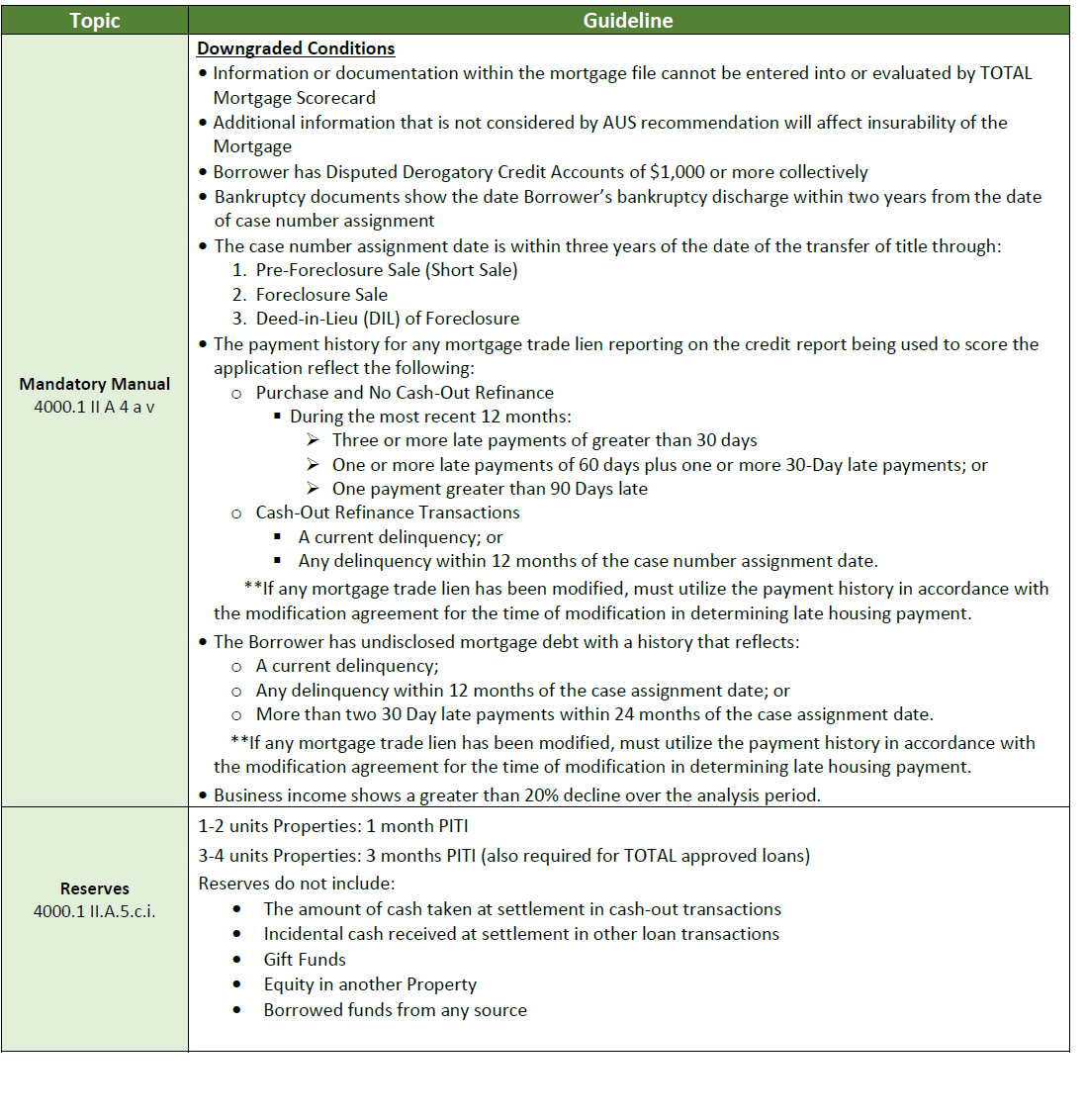
Accept Risk Class required downgrade to Manual Underwriting


The Mortgagee must downgrade and manually underwrite any mortgage that received an accept or approve/eligible recommendation if:
• The mortgage file contains information or documentation that cannot be evaluated by TOTAL.
• Additional information, not considered in the AUS recommendation affects the overall insurability of the mortgage.
• The borrower has $1,000 or more collectively in Disputed Derogatory Credit Accounts.
• The date of the borrower’s bankruptcy discharge as reflected on bankruptcy documents is within two years from the date of the case number assignment.
• The case number assignment date is within three years of the date of the transfer of title through a Pre-Foreclosure Sale (Short Sale).
• The case number assignment date is within three years of the date of the transfer of title through a foreclosure sale.
• The case number assignment date is within three years of the date of the transfer of title through a Deed-in-Lieu (DIL) of foreclosure.
• The Mortgage Payment history, for any mortgage trade line reported on the credit report used to score the application, requires a downgrade as defined in Housing Obligations/Mortgage Payment History.
• The Borrower has undisclosed mortgage debt that requires a downgrade.
• Business income shows a greater than 20 percent decline over the analysis period.


How Do I Qualify for An FHA Loan in Kentucky based on score, income, work history and credit?

How to Get a Kentucky FHA Mortgage Loan

If you’re a first-time homebuyer in Kentucky or simply looking for an accessible loan option, an FHA mortgage loan is worth exploring. With low down payments, flexible credit requirements, and potential for down payment assistance, FHA loans provide a pathway to homeownership for many Kentucky residents. Here’s everything you need to know about qualifying for and securing an FHA loan in Kentucky.

Kentucky FHA Mortgage Loan Options to consider


1. Low Down Payment


–  FHA Mortgage Loans only require a 3.5% down payment. And what makes that even more attractive is that it can be a gift from a relative. Do you have a parent or sibling who would “Gift” you some money for a down payment? If so, it could be time to apply for an  FHA Mortgage Loan.

2.Flexible Credit Qualifying

– HUD did NOT set a credit score requirement for qualifying for an  FHA Mortgage Loan. However many lenders in the market today have drafted “Overlays” that set minimum credit score requirements. Most lenders like to see a minimum 580 to 620  credit score, but don’t get discouraged if you are not there yet. If you are close to 620, it is often just as simple as reviewing your credit to determine how to quickly raise it. If you are not close to 620, ask your FHA Mortgage Loan Originator if they have a program for you. Chances are, there is! Bankruptcies and prior foreclosures do not automatically disqualify you either.

3.The Seller Can Pay Your Closing Costs

– That’s right. You need to have a quality Realtor who will help you negotiate not only the best price for the home, but also that the seller will pay your closing costs. HUD allows FHA Mortgage Loans to have the seller pay up to 6% of the purchase price. Sounds good so far, a down payment gift and seller paying closing costs!

4.Flexible Income Qualifying

– The standard for income qualifying ratios is 31/43 which means that up to 31% of your monthly income can be used to pay your monthly household mortgage payment; and up to 43% of your monthly income can be used to qualify for ALL monthly expenses. Those ratios can go up to 55% if you have good credit and a good income history allowing you to qualify when others might not.

5.Qualify Without Your Spouse’s BAD Credit –

This is a tricky one but it is also not well known. You can effectively qualify for an FHA Mortgage Loan without your spouse’s Bad Credit. FHA will look at your spouse’s credit but cannot decline your loan due to your spouse’s debt or credit score. So if you have a spouse with a crummy credit profile, you should take a look at  FHA Mortgage Loans to see if it will work for you.

Kentucky FHA Mortgage Requirements 


An FHA loan is a mortgage issued by federally qualified lenders and insured by the Federal Housing Administration (FHA). FHA loans are designed for low-to-moderate income borrowers who are unable to make a large down payment.

Minimum Credit Score is 500 with at least 10% down
Minimum Credit Score is 580 if you put less than 10% down
The FHA Kentucky Maximum loan for 2023 is $472,030
Upfront and Monthly Mortgage Insurance is required regardless of the Loan to Value
FHA Loans are only available for financing primary residences
Maximum Debt to Income Ratio of 50% (unless mitigating factors justify allowing a higher DTI)


Borrowers must have a steady employment history of the last two years within the same industry or line of work. Recent college graduates can use their transcripts to supplant the 2-year work history rule as long as it makes sense
Self-Employed will need a 2-year history of tax returns filed with IRS. They will take a 2-year average.

FHA requires a 3.5% down payment. Can be gifted from family member or from retirement savings plan, or money saved-up. Any type of cash deposits is not allowed for down payments. No exceptions to this rule!! This is one of the biggest issues I see in FHA underwriting nowadays.

 FHA loans are for primary residence occupancy. Not rental houses.

Borrowers must have a property appraisal from a FHA-approved appraiser.

Borrowers’ front-end ratio (mortgage payment plus HOA fees, property taxes, mortgage insurance, homeowners’ insurance) needs to be less than 31 percent of their gross income, typically. You may be able to get approved with as high a percentage as 43 percent. If the Automated Underwriting System gives you an Approved Eligible you can go higher on the debt ratios
Borrowers must have a minimum credit score of 580 for maximum financing with a 3.5% down payment

Borrowers must have a minimum credit score of 500-579 for maximum LTV of 90 percent with a minimum down payment of 10 percent. Most lenders will not go below 580 to 620 score, and very few lenders will go to 580 score. It’s best to work on getting your scores up before you apply or work with a loan officer to improve them.
2 years removed from Chapter 7 is required with good pay history after bankruptcy

1 year removed from Chapter 13 is okay with an excellent pay history with the Chapter 13 plan and permission from trustee. You will need to qualify with the Chapter 13 payment along with new house payment. Again, scores will play into your loan pre-approval.

Typically, borrowers must be three years out of foreclosure and have re-established good credit. Exceptions can be made if there were extenuating circumstances and you’ve improved your credit. If you were unable to sell your home because you had to move to a new area, this does not qualify as an exception to the three-year foreclosure guideline.

Pros and cons of Kentucky FHA loans


Pros


  • You can have a lower credit score: If you haven’t established much of a credit history or you’ve encountered some issues in the past with making on-time payments, a 620 credit score — the typical magic number for consideration of a conventional mortgage — might seem out of reach. If your credit score is 580, you’re in good standing with most FHA-approved lenders.
  • You can make a lower down payment: FHA loans also give the option for a smaller down payment. With a credit score of at least 580, you can make a down payment of as little as 3.5 percent. If your credit score is between 500 and 579, you may still be able to qualify for an FHA-backed loan, but you will need to make a 10 percent down payment.
  • You can stop renting earlier: Since FHA loans make buying a home easier, you can start building equity sooner. Instead of continuing to rent while trying to save more money or improve your credit score, FHA loans make the dream of being a homeowner possible sooner.
Cons


  • You won’t be able to avoid mortgage insurance: Since your credit score is lower, you’re a bigger risk of default. To protect the lender, you have to pay mortgage insurance. You can roll the upfront insurance premium into your closing costs, but your annual premiums will be divided into 12 installments and show up on every mortgage bill. If you put down less than 10 percent, you have to pay those annual premiums for the entire life of the loan. There’s no escaping them. That’s a big difference from conventional loans: Once you build up 20 percent equity, you no longer have to pay for private mortgage insurance.
  • You’ll have to meet property requirements: If you’re applying for an FHA loan, the property has to meet some eligibility requirements. The most important is the price: FHA-backed mortgages are not allowed to exceed certain amounts, which vary based on location. You have to live in the property, too. FHA loans for new purchases are not designed for second homes or investment properties.
  • You could pay more: When you compare mortgage rates between FHA and conventional loans, you might notice the interest rates on FHA loans are lower. The APR, though, is the better comparison point because it represents the total cost of borrowing. On FHA loans, the APR can sometimes be higher than conventional loans.
  • Some sellers might shy away: In the ultra-competitive pandemic housing market, sellers weighing multiple offers often viewed FHA borrowers less favorably.


Joel Lobb
Mortgage Loan Officer

Individual NMLS ID #57916


Text/call: 502-905-3708

email:
 kentuckyloan@gmail.com

http://www.mylouisvillekentuckymortgage.com/


The view and opinions stated on this website belong solely to the authors, and are intended for informational purposes only. The posted information does not guarantee approvalnor does it comprise full underwriting guidelines. This does not represent being part of a government agency. The views expressed on this post are mine and do not necessarily reflect the view of my employer. Not all products or services mentioned on this site may fit all people.
NMLS ID# 57916, (www.nmlsconsumeraccess.org).


Kentucky FHA Loans with Bad Credit in 2023.

How to get approved for a Kentucky FHA Mortgage Loan with Bad Credit in 2023.


Below details the DTI requirements The maximum Front and Back ratios applicable to manually underwritten Kentucky FHA Mortgages are detailed below. 

Maximum DTI allowed for Manual UW is 40/50 

**IMPORTANT – any loan where ALL borrowers have No Fico Score, the Maximum DTI is 31/43 per HUD DTI and Compensating Factor Requirements: 

560 FICO and Above – DTI up to 31/43.Comp Factors Required - NONE. 

560 FICO and Above - DTI up to 37/47Comp Factors Required– 1 Required 

560 FICO and Above – DTI up to 40/50Comp Factors Required– 2 Required

ACCEPTABLE COMPENSATING FACTORS:

RESERVES – 3 mo (1-2 Unit) 6 Mo (3-4 Unit)

HOUSING DECREASE – new PITI is no more than $100 or 5%, the lesser of the two

RESIDUAL – Meet VA residual requirements

ADDITIONAL INCOME – Income not reflected in DTI (this comp factor is only permitted when DTI is over 37/47 and if income were used, it would decrease DTI under 37/47)

DTI requirements The maximum Front and Back ratios applicable to manually underwritten Kentucky FHA Mortgages


MANUAL UNDERWRITE REQUIREMENTS ON ALL LOANS

12 Months verified housing history OR rent free letter,

Reserves, AND

1 month reserves for 1-2 Unit

3 month reserves for 3-4 Unit

NOTE: If you use reserves as a compensating factor, then you do not need these reserves in addition

Letter of explanation for all derogatory credit, including any NSFs and/or overdrafts in bank accountIf applicable, 2 months for all bank statements in the file (60 days activity)

Maximum DTI 40/50 (HUD guideline, no exceptions


Instructions for Residual Income as Compensating Factor

Residual income may be used as compensating factor when it meets or exceeds the stated amounts in

the table below. Note that all household members must be counted for ‘family size’ except for individuals

who are fully supported from a verified source of income not included in the effective income of the loan.

Residual Income as Compensating Factor for Kentucky FHA Mortgage Loan


Residual Income Calculation When Needed as a Compensating Factor

Gross Monthly Income1 2

- (State income taxes3)

- (Federal income taxes3)

- (Municipal or other taxes3)

- (Retirement deductions and/or Social Security deductions)

- (Total monthly housing payment)

- (Estimated maintenance and utilities4)

- (Job related expenses (e.g., childcare)5)

= Monthly Residual Income for Family Support.

[When using Residual Income as a compensating factor, the “Monthly Residual Income for Family Support” must

meet or exceed the dollar amount in the “Residual Income Table” above.

1 Income from occupying borrowers only

2 Non-taxable income may not be grossed up

3 Federal and state taxes must be used to determine appropriate deductions or paystub if taxes are not available

4 Multiply total living area (sq ft) x 14

5 Childcare letter is not required (as it is for VA) and should not be requested

Exceptions to the Required Residual Income

You may reduce the residual income figure from the above tables by 5% if:

1. The borrower(s) is an active duty or retired serviceperson, OR

2. There is a clear indication that a borrower will receive the benefits resulting from use of military-based

facilities located near the property.

Examples of military service for reduced residual income are:

Guard and Reserve military retirees, 100% disabled Veterans and their family members, or Medal of Honor

recipient.


Kentucky FHA Mortgage Lender for Bad Credit in 2023


Joel Lobb
Mortgage Loan Officer

Individual NMLS ID #57916


American Mortgage Solutions, Inc.
10602 Timberwood Circle
Louisville, KY 40223
Company NMLS ID #1364


Text/call: 502-905-3708
fax: 502-327-9119
email:
 kentuckyloan@gmail.com

http://www.mylouisvillekentuckymortgage.com/

The view and opinions stated on this website belong solely to the authors, and are intended for informational purposes only. The posted information does not guarantee approvalnor does it comprise full underwriting guidelines. This does not represent being part of a government agency. The views expressed on this post are mine and do not necessarily reflect the view of my employer. Not all products or services mentioned on this site may fit all people.
NMLS ID# 57916, (www.nmlsconsumeraccess.org).


Kentucky FHA Mortgage Loans

Kentucky FHA Loan Requirements For 2022 How to Qualify for a Kentucky FHA Mortgage Loan with a lender?

Kentucky FHA Mortgage Guidelines in Video


Joel Lobb
Mortgage Loan Officer
Individual NMLS ID #57916

American Mortgage Solutions, Inc.

Text/call:      502-905-3708
fax:            502-327-9119
email:
          kentuckyloan@gmail.com


What is a Good Credit Score for a Kentucky FHA, VA, USDA, Fannie Mae Conventional KHC Mortgage Loan Approval?

What is a Good Credit Score

What is a Good Credit Score?

An established credit history and credit score often stands between potential home or car buyers and their dream. But What is a good credit score? What exactly is a credit score? What makes a credit score “good?” How to improve your credit score? If you’re new to building credit there are a few things you need to know in order to keep your credit looking stellar.
What is a credit score?
Your credit score is a numerical representation of your credit report. This three-digit number is like a badge that predicts risk, credit responsibility and determines your interest rates if you borrow money from lenders much like your CLUE Report. While you will be able to get a copy of your credit report you may not find this numerical key listed. Think of your credit score like the cliff notes version of your credit report. There are a few different measures of credit scores between divisions. Based on their own systems different scorers might view certain numbers in many ways.
what is a good credit score
Deciphering your three-digit credit score is quite easy if you know the levels. The range usually runs from 300-850. Good to excellent credit is considered anything from 700 to 850. If your credit score falls in this range you’re going great! Fair credit runs from 625-699, poor runs from 550-624, and anything below 550 is bad. Some finance experts would classify anything over 720 a good credit rating. Experts will disagree depending on their preferred credit rating systems, and in most cases the criteria you use to determine whether or not your credit score is good will not be far off.
What Does a Good Credit Score Mean?
Having a good credit score is great, but if you don’t know how to use it you could be missing out on some crucial credit building. Credit scores are used in varying ways by lenders and banks. One thing your credit score implies is how likely you are to pay back debt. Basically it announces how reliable you are as a borrower. People with good credit scores are more likely to pay back funds that they borrow while those with lower scores aren’t so reliable. Lenders like reliable borrowers, and good credit points them out.
But a credit score does much more than predict whether or not you’ll pay a loan back. When it comes to buying a house or car, there is an interest charge. Higher credit scores usually have a lower interest rate than those with bad to fair credit. Lenders not only base whether or not they’ll approve a loan by your credit score, but also how much interest to charge. If your credit is in good standing your interest rate won’t be as high as someone with bad credit. Your credit score saves you money with lower interest rates.
How is a Credit Score Calculated?
In order to build and maintain good credit you must first know how your score is determined. Once you know what goes into a credit score you can begin building your credit or nursing your score towards higher digits. Credit scores are based on your financial history only, and laws prevent your score being affected by things like race, gender, age and where you live. What is included are items such as your payment history, your current credit debts, age of your credit history, new credit items added to your accounts and types of credit used.
These five basic areas are where the bulk of your credit score is formed. All criteria have varying degrees of involvement in your score. For example:
  • Payment history (35%) – How many on-time payments you’ve made, missed, defaulted and past due items
  • Current amount owed (30%) – How much you currently owe – if you owe a large amount this could negatively affect your score
  • Age of credit history (15%) – The average length of your credit accounts and time since last activity
  • New credit (10%) – The number of new credit items on your accounts
  • Types of credit (10%) – The kinds of credit accounts are you currently maintain
How to Improve Your Credit Score?
Many people avoid credit based on all the negatives they’ve heard against it, but neglecting your credit score hurts your chances of being able to make major purchases in the future. The best way to build credit is to use credit, and forming the following good credit habits early will pull your low score to higher ground.
  • Pay bills on time – This is the easiest and best way to boost your credit score. Since the bulk of your credit score comes from your payment history, paying bills on time will pull you up quickly. Not only will that help, but a recent and consistent history of paying bills on time overshadow a period long in the past where you may have missed payments.
  • Budget – Setting up a budget and staying within its parameters will keep you from overspending and using credit for frivolous things. Although using credit builds credit not being able to pay it off hurts more in the future.
  • Use all your credit cards regularly – If you have a few credit cards try to use them from time to time in order to show that you use all of your accounts. Remember that the last usage of an account is 15% of your score.

Track a key aspect of your financial profile with your personal FICO® Score history graph. Simply navigate over any point of your score history and view the date the score was calculated. Check back each month to stay on top of changes.

Important items to note:

  • We may not receive a new score for you each month. You won’t see a score if we did not receive one for a given month.
  • Remember, FICO® Scores are based on data in your credit report, so changes to your score may be a result of changes in your credit report. You can request a free annual credit report from Equifax at www.annualcreditreport.com.
Please refer to our FAQs or Useful Links sections for more information.

FICO® Scores: What You Need to Know

Score Deciding Factors

35% payment history, 30% amount you owe, 15% length of credit history, 10% new credit opened, 10% type of credit.
 

Understanding Credit Reports and Credit Scores

When it comes to getting a home loan, does your credit report and credit score really matter? Can you use the free credit score you got off the internet to apply for a loan?  What if your credit score is low, can you get a mortgage? What if it is high, will you get a better interest rate? And what the heck is FICO?
So many questions. You’ve searched the internet and are still confused. If you are new to getting a mortgage and are overwhelmed by understanding your credit score you are not alone. Your credit score has a big  impact on your ability to qualify for a loan and get a favorable interest rate. Therefore, you should take the time now to understand it.
Here’s the good news. We’re here to explain things simply and clearly. Step by step we will walk you through all things credit. When we’re done, you’ll know what you need to know to understand how credit impacts your ability to get a mortgage so you can make smart home buying decisions.
Below are the important items we will discuss:
  • What is a credit report?
  • What do mortgage lenders use to determine my credit score?
  • What does FICO stand for?
  • What determines my FICO score?
  • What’s a good FICO score?
  • What if my FICO score is below 620?
  • Can I get a copy of my credit report?
  • Ah Ha! Now I understand all things credit and I’m this much closer to owning my home!
What is a credit report?
A credit report record’s your credit history including information about:
  • Your identity: name, social security number, date of birth and possibly employment information.
  • Your existing credit: credit card accounts, mortgages, car loans, students loans etc.including credit terms, how much you owe, and your payment history.
  • Your public record: Judgments against you, tax liens or bankruptcies.
  • Recent Credit Inquiries: Requests for your information from companies extending credit such as credit card companies, auto loans, etc.
Be aware, credit card companies, car companies and mortgage lenders use slightly different models to determine credit risk. Today we are focusing on Mortgage related credit.
How do lenders calculate my credit score?
Your credit score is the key to your castle. Your home is most likely the most expensive purchase you will ever make. Therefore, when buying a home, lenders use a different system for assessing risk than credit card companies or even auto loan companies use.
Mortgage lenders use a comprehensive system of checking credit called a Residential Mortgage Credit Report (RMCR), commonly called a “Tri-Merge” report. The RMCR report combines your three credit reports from the three national credit bureaus, Equifax, Experian, and TransUnion. Each credit reporting agency calculates your credit score or FICO Score differently. Therefore, pulling from all three bureaus gives lenders a more complete picture of your credit behavior.
Once pulled, lenders use the average of these three scores, usually the middle score, to determine loan qualification and interest rate. For example, if Equifax gives you a 720, Experian a 730 and TransUnion a 740, the lender will use the 730 FICO Score to help determine the terms of your mortgage. If you are applying for a loan jointly, your partner’s three reports will also be pulled.
What does FICO stand for?
FICO stands Fair, Isaac and Company. Over 25 years ago, lenders began using FICO’s scoring model, or algorithm, to fairly and more accurately determine a person’s credit risk. Since it’s inception, FICO’s continually updates its’ algorithms to reflect more current lending trends and consumer behaviors. Today, FICO Scores are used by over 90% of enders. Importantly, your FICO score can impact your loan interest rates, terms, approvals and more.
What determines my FICO score?
A Mortgage FICO score is determined by an algorithm that generally looks at five credit factors including payment history, current level of indebtedness, types of credit used, length of credit history and new credit accounts.
What do FICO scores look at?
What’s a good FICO score?
To qualify for a conventional loan, most Mortgage lenders require a FICO score of 620+. The best interest rates go to borrowers with a 740+ FICO score. For each 40 point drop, borrowers can expect to see a slightly higher interest rates by about 0.2 percentage points.  If a borrower drops below 660, the increase is likely to be twice as big, a 0.43 percentage point increase. If your credit score is below 620, it is very difficult to get a conventional loan in today’s marketplace. However, don’t be discouraged. You may still be able to buy a home.
Qualifying Credit Scores
What if my FICO or credit score is below 620?
If your score is below 620, you may still be able to buy a home. There are several options:
  • Put more money down. Some lenders offset a weak credit score with a higher down payment. A higher down payment gives you more equity in your home, lowering the lender’s risk.  
  • You may qualify for a non conventional government issued loan such as an FHA, Veterans Affairs and/or U.S. Department of Agriculture loan which have less stringent lending requirements.
  • You may work to get that credit score up!
    • Correct any errors on your report. Analyze your credit items line by line. If you notice a mistake, dispute it right away with either the credit bureau providing the report or the company that providing the incorrect information to the credit bureau.
    • Make all your payments on time. Late payments are the No. 1 way to lower  your credit score.
    • Pay down revolving debt. Keeping your credit balances low helps to raise your score.  
    • Sit back and relax. As long as you're paying down debt and making payments on time, your credit score will eventually rise on its own.
Can I get a copy of my credit report after a lender has pulled it?
Yes! In fact, you can get one free credit report every twelve months from each of the nationwide credit bureaus—Equifax, Experian, and TransUnion. You may also purchase your credit score at any time from any of the credit bureaus. Some Mortgage lenders will tell you your score when you apply for a loan or even give you a copy of your report but they are not required to do so. However, if a lender denies you credit, under the Fair Credit Reporting Act (FCRA) you are entitled to a free copy of your personal credit report if you have received notice that in the past 60 days you have been declined credit
n order to get approved for most homes loans nowadays that are sold to FHA, VA, USDA, Fannie Mae and Kentucky Housing, you will need to have a 620 credit score for most programs, with FHA, USDA, and VA going


Joel Lobb
Mortgage Loan Officer
Individual NMLS ID #57916

American Mortgage Solutions, Inc.
10602 Timberwood Circle 
Louisville, KY 40223
Company NMLS ID #1364


Text/call:      502-905-3708
email:          kentuckyloan@gmail.com


http://www.emailmeform.com/builder/form/0bfJs9b6bK8TGoc6mQk9hIu


Disclaimer: No statement on this site is a commitment to make a loan. Loans are subject to borrower qualifications, including income, property evaluation, sufficient equity in the home to meet Loan-to-Value requirements, and final credit approval. Approvals are subject to underwriting guidelines, interest rates, and program guidelines and are subject to change without notice based on applicant's eligibility and market conditions. Refinancing an existing loan may result in total finance charges being higher over the life of a loan. Reduction in payments may reflect a longer loan term. Terms of any loan may be subject to payment of points and fees by the applicant  Equal Opportunity Lender. NMLS#57916 http://www.nmlsconsumeraccess.org/

-- Some products and services may not be available in all states. Credit and collateral are subject to approval. Terms and conditions apply. This is not a commitment to lend. Programs, rates, terms and conditions are subject to change without notice. The content in this marketing advertisement has not been approved, reviewed, sponsored or endorsed by any department or government agency. Rates are subject to change and are subject to borrower(s) qualification.